Too many people approach searching for a senior living community the same way they approach buying a new house. They have a checklist of must-haves, like square footage, amenities, meal plans, and price per month. All of that matters, but it only scratches the surface. If a checklist is the only lens you’re looking through, you might end up somewhere beautiful that never quite feels like home.
The people who tend to thrive in retirement communities, who build genuine friendships and settle in with a sense of ease, usually made their decision based on something harder to quantify. They walked in and felt something. But before you can feel anything about a community, you have to get yourself in front of the right ones. That starts with a little homework.
How to Choose a Senior Living Community:
- Use a checklist to start and narrow your search, but not to make your decision.
- Prioritize what you’ll actually need in your golden years.
- Visit communities and listen to your gut for a vibe check.
- Ask for stories, not statistics.
- Look for somewhere that gives you more life , not less.
- Don’t wait until you feel like you have to.
1) Use a checklist to start and narrow your search, but not to make your decision.
Before you visit anywhere, some basic research can help you filter out communities that simply won’t work and focus your energy on the ones worth your time. You can’t fall in love with a community you can’t afford, and you won’t be happy living somewhere that doesn’t align with your values.
Most of these questions can be answered by browsing a website or making a quick phone call. If you’re unsure what to look for or include in your checklist, here are some ideas to get you started:
- Retirement community cost and financing options: What is and isn’t included? How might pricing change over time?
- Level of care: Can the community support you as your needs evolve? Or will you have to relocate?
- Location: Is the community close to your family? What’s the weather like? Is there nearby access to medical care?
- Amenities and dining: Do the day-to-day offerings align with how you like to live life?
- Living your values: Does the community
Once a community clears those hurdles, the real evaluation begins. Now’s when you’ll have to schedule a visit because you’ll need answers to questions you can’t get over the phone or read on a website.
2) Prioritize what you’ll actually need in your golden years.
There’s a version of retirement planning that focuses almost entirely on finances and logistics, and largely ignores two things that research consistently shows matter most to how long and how well people live: social connection and access to care as needs change.
According to a 2025 AARP study, 40% of U.S. adults over 45 now report feeling lonely, up from 35% in both 2010 and 2018. And loneliness carries real health consequences! Research has found that social isolation or loneliness in older adults is associated with a 50% increased risk of developing dementia, a 30% increased risk of coronary artery disease or stroke, and a 26% increased risk of all-cause mortality. Those risks have compared to being the equivalent of smoking 15 cigarettes a day.
This is one of the most underappreciated arguments for finding a retirement community where you genuinely connect with the people around you. Belonging somewhere, and having people to belong with, is one of the most protective things you can do for your health.
Since about 70% of older adults will need some kind of long-term care during their lifetime, the care question is equally important to think through early. It’s not a reason to panic, but it is a reason to choose a community with enough range in its care options to support you as your needs evolve, rather than one that works perfectly for you today but requires a disruptive move later. When you’re evaluating communities, ask what the continuum of care looks like. Ask what happens if your needs change significantly. The goal is to find somewhere you can stay, not somewhere you’ll eventually have to leave.
3) Visit retirement communities and listen to your gut for a vibe check.
When you’re on tours, pay less attention to the finishes and more attention to the feelings.
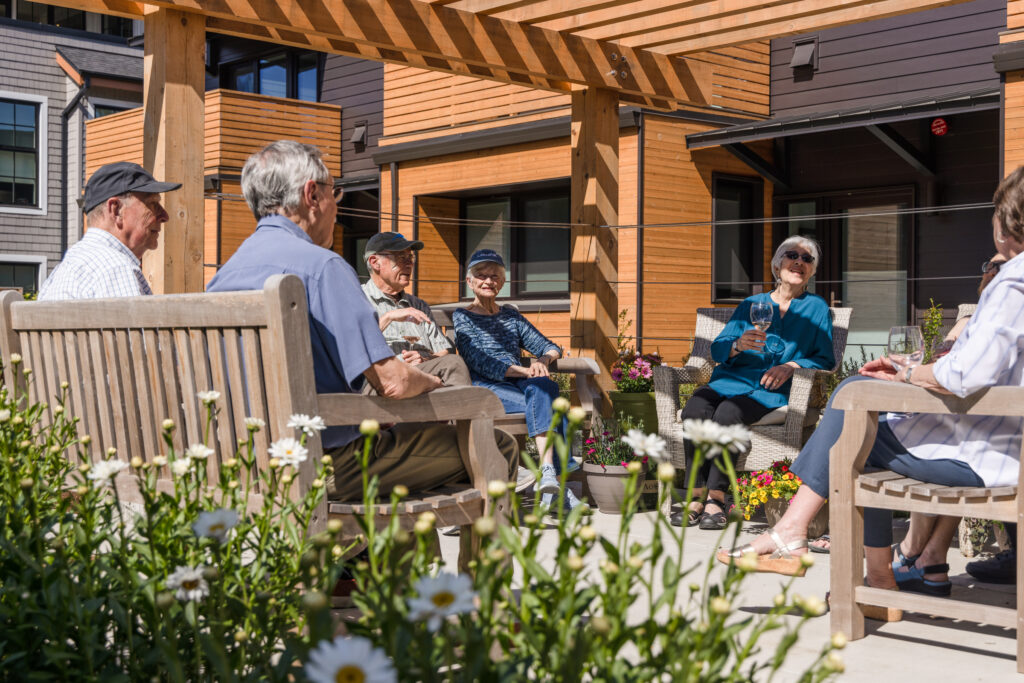
Where you choose to move should be much more aligned with the culture and sense of belonging you feel when you are visiting campus. Do the Residents you meet feel like people who could be friends? Do you see yourself fitting in with the vibe of the community? Do their core values resonate with you?
A retirement community is a social world and you need to decide whether or not you want to be a part of it.
It’s also worth giving yourself permission to not feel it everywhere you visit. Not every community will be the right fit for you, and that’s just part of the process. A community that tries to appeal to everyone tends to have a diluted identity, and a diluted identity is exactly what makes it hard to feel like you truly belong somewhere. The communities with the strongest sense of culture are often a little specific, a little particular, or maybe even a little quirky. Our own Residents would be the first to tell you we’re not for everyone. That specificity is what makes Rose Villa home for the people it is right for. So if you walk out of a tour and something feels off, trust that. Your people are out there.
Also pay particular attention to how you’re welcomed, and notice if it feels like you’re being sold to or genuinely welcomed. A community where people are happy tends to show up in small, unscripted moments, like a Resident who stops to chat unprompted, or a Team Member who knows everyone by name. Those small gut checks tell you a lot more than an amenity list.
4) Ask for stories, not statistics.
One of the most common mistakes families make on a tour is letting the presentation do all the talking. They see the dining room, the fitness center, the model unit, and they start rationalizing. They start falling in love with the kitchen before they’ve decided if the culture is the right fit.
Here’s a better move for when you’re visiting a retirement community: ask a Team Member for a Resident story. Ask whether anyone came in uncertain and left clear. Ask whether any Resident almost chose a different community, and what made the difference. Good communities have these stories and can tell them easily, because they’ve lived alongside them. If the answer feels rehearsed or vague, that’s worth noting.
5) Look for somewhere that gives you more life, not less.
There’s a persistent fear that moving into a retirement community means giving something up, like your independence, identity, or the feeling of being fully yourself. In practice, the opposite is usually true.
When we ask our Residents what surprises them most about daily life after moving to Rose Villa, their answer usually boils down to the amount of autonomy they still feel, and the relief that comes with that. They feel relieved that the move is over, and that they feel at home. They realize that they are still themselves, they just have a little more freedom to do what they want to do without quite so many household chores.
What they’ve given up is the overhead of everyday life and the everyday tasks they were tired of. Things like yard work, scheduling repairs, and the daily weight of managing a house. When that lifts, what tends to emerge is a life where they can truly be themselves. With more time for the things they actually want to do, and more energy for the people they want to spend it with.
So when you’re evaluating a community, it’s worth asking not just whether you’d feel at home there, but whether you’d feel like yourself. Does the rhythm of daily life there make room for who you are, and not just who you might eventually need to be?
6) Don’t wait until you feel like you have to.
Finally, if there’s one thing we hear more than anything else after a Resident moves in, it’s that they should have done it sooner. In years of conversations with new Residents, we genuinely never hear the opposite.
The Residents who thrive most are almost always the ones who moved in before they felt they needed to, while they still had the energy to build friendships, explore the community, and arrive as contributors rather than people who needed to be cared for. Moving in from a position of strength means you become part of the fabric of the community; a Resident who makes the next new Resident feel welcome.
There’s a financial case for it too since costs in retirement communities tend to increase over time. Moving sooner locks you in at a lower baseline than waiting another year or two will. The hesitation is understandable, but in our experience it’s almost never validated by what’s on the other side of it.
Frequently Asked Questions
How many communities should I visit before making a decision?
It’s hard to say since it’s different for everyone. If the first community you visit feels like the perfect fit, that can be enough. However, visiting at least three different communities is a good idea to be able to make comparisons between and be sure you’re making the right decision.
What if my needs change after I move in?
This is one of the most important questions to ask while you’re evaluating your options, as retirement communities offer varying levels of continuum of care. One of the key things to look for in a retirement community is that it can handle whatever your needs are without having to uproot your life.
Is it hard to make friends as a new Resident?
What most new Residents find is that a good retirement community removes most of the friction that makes adult friendships hard in the first place. Since the opportunities to make friends, things like shared meals, retirement community activities, and common spaces, are built into daily life, friendships tend to grow naturally.
Let your heart guide you!
When you’re choosing the best retirement community for your needs, start with a checklist but never treat it as the finish line. Use it to find communities worth visiting, then set it down when you get there.
The question that actually matters, does this feel like somewhere I could really live? is one only you can answer for yourself. Fortunately, when you find the right place, it usually comes to you pretty quickly if you let yourself listen.
If you’re considering a retirement community in Portland, OR, our TakeRoot 101 program is a great opportunity to visit our 24-acre campus, experience retirement community outdoor living, and get a clear overview of everything you need to know.